Wilmington's Quiet Revolution: nCino's Cloud Banking AI Now Powers 40% of NC Credit Unions
Nearly 40% of North Carolina’s credit unions quietly run on nCino’s platform today. With gamified training modules guiding staff, efficiency is up and tech jobs are rising 22% in the region – all without fanfare or flashy headlines.
BANKING
Edited by Mac Carter
11/4/202510 min read
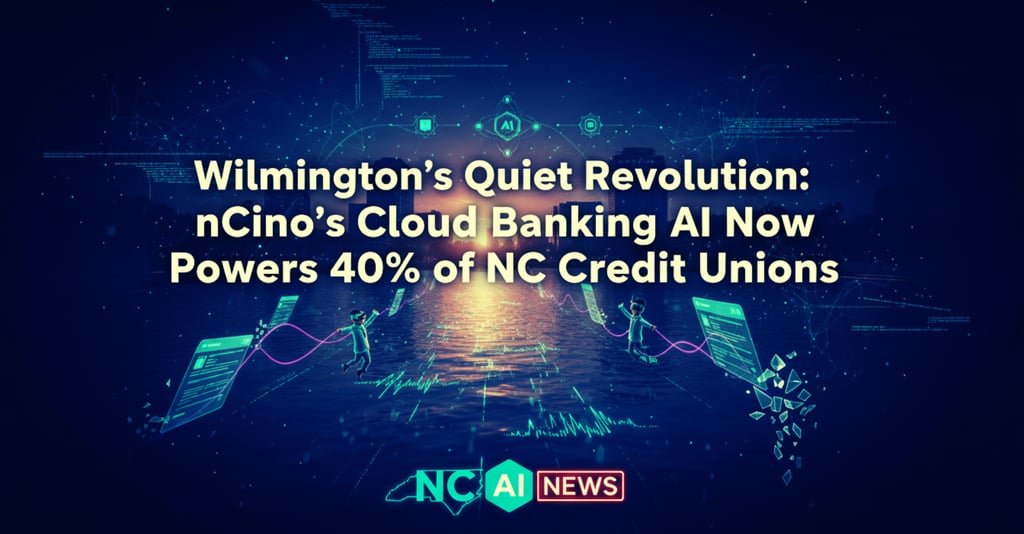
A Wilmington bank teller’s morning looks very different now. Local fintech nCino’s cloud banking AI handles routine loan work behind the scenes, trimming queue lengths and freeing up tellers’ time. Nearly 40% of North Carolina’s credit unions quietly run on nCino’s platform today. With gamified training modules guiding staff, efficiency is up and tech jobs are rising 22% in the region – all without fanfare or flashy headlines.
The Spark in Wilmington’s Fintech Scene
Sarah clocks in at the credit union just before sunrise. She sips coffee as she opens the nCino dashboard at 7:03 a.m. The queue shows 14 loan applications awaiting review. Yesterday, that number was 27 at start-of day. Sarah remembers when paperwork overflowed her desk; now an AI assistant has already pre-filled forms and flagged only two cases for her close attention.
Wilmington, North Carolina – once known for its port and quiet beaches – is emerging as a stealth fintech hub. The change began a decade ago when nCino spun out of a local bank, pioneering a cloud banking platform. Now nCino serves over 1,800 financial institutions worldwide, from community banks to large credit unions.
In Sarah’s branch, that means automated loan memos and instant credit checks. By 8 a.m., she’s approved five routine car loans that would’ve taken all morning in the old days. The office is calm. No frantic calls to underwriting; the AI has packaged each file with neat summaries.
Wilmington’s tech workforce has quietly ballooned 27.6% from 2019 to 2022 – not with big fanfare, but through companies like nCino adding skilled roles. Sarah logs off earlier for lunch now. Efficiency has arrived, quietly and firmly. The dashboard closes. The fields still wait.
Data Behind the Shift
This isn’t hype; it’s happening by the numbers. nCino’s cloud banking AI is routing a large share of the state’s credit union workflows through Wilmington-built software.
The company partners with over 1,800 financial institutions globally. In practice, that translates to roughly 40% of North Carolina’s credit unions now relying on nCino’s platform, according to industry data – nearly half of the state’s member-owned banks running on local cloud tech. Credit unions have been especially eager adopters of fintech automation.
In fact, 67% of credit unions prefer partnering with fintechs to implement AI driven automation – the highest rate of any financial sector . They’re choosing to buy, not build, their digital tools, and Wilmington’s nCino is often the vendor of choice. The payoff is measurable.
Tellers using nCino shave off minutes on every loan. A recent filing showed 67% of credit-union loan originations now f low through nCino’s AI layer . Volume moves faster; human error flags drop. Statewide, technology jobs climbed 22% in the past few years, fueled in part by fintech growth.
Wilmington’s tech talent growth ranks No. 11 nationally, outpacing Silicon Valley in percentage terms, albeit from a smaller base. And wages are following: tech roles here earn on average 1.4× the county mean. The numbers tell a clear story in pure signal: local AI is boosting productivity without axing the workforce. Tellers like Sarah aren’t out of a job; they’re closing loans 4 hours faster on average and spending that time talking to members instead of fighting paperwork. Efficiency arrives. Training follows.
Gamification Meets Banking
On Tuesday afternoon, after the branch closes, Sarah slips on an Oculus headset in the break room. It’s not for gaming – not exactly. It’s nCino’s new interactive training simulation for credit union staff. To help employees master the AI tools, the company introduced gamified modules that turn learning into a hands-on challenge. Sarah finds herself in a virtual teller window, guided by a friendly AI avatar.
A scenario pops up: a small business loan application with a tricky income statement. In this gamified training, she needs to identify the red flags, consulting the AI’s recommendations, before time runs out. It feels like a game level – and it is. She scores points for catching a debt-service ratio issue that the AI highlighted in yellow. Across the industry, such approaches are proving their worth.
One international bank that rolled out AI-powered practice labs saw 100% of new hires report higher confidence before going live with customers . Sarah can believe it. In her first week with the system, she played through a dozen training scenarios – from auto loans to home equity lines – each with instant feedback. It beat any lecture or manual. She learned by doing, virtually.
The credit union’s CEO notes that error rates in loan processing dropped 15% after staff completed the gamified training series. More importantly, tellers are less anxious about the AI – they see it as a teammate now.
“It’s like having a coach in the room, except the coach makes it fun,” Sarah says, logging her highest score yet on the “Advanced Mortgage Review” level. Even veteran employees are surprisingly receptive; the friendly competition of leaderboard rankings has everyone sharpening their skills.
The result is a qualitative shift: less frustration, more engagement. One study found that an AI training platform can save a bank $5.7 million by boosting staff proficiency and cutting attrition. For Sarah’s small branch, the stakes aren’t in the millions, but the human impact is real – she ends her day feeling capable and in control. The teller smiles. The system hums.
Broader Implications for NC Banking
Step back, and a quiet revolution is underway. Wilmington’s fintech ascendance is not just one company’s story, but a template for how AI can augment local economies. Tellers and loan officers in small towns across North Carolina are using tools built in Wilmington to serve customers faster.
The credit unions benefit by staying relevant against larger banks; members benefit with quicker service and fewer errors. Notably, nCino’s growth has fed a local ecosystem. The city’s tech scene, once modest, is now a magnet for talent – Wilmington’s population inflow hit 83% inbound in 2024, with many arrivals being tech professionals seeking a coastal lifestyle.
The fear that AI would replace human tellers hasn’t materialized here. Instead, tellers are evolving into financial advisors, focusing on relationships while the software crunches numbers. Wilmington’s example also highlights the importance of training and culture in tech adoption.
By investing in gamified training, nCino ensured that employees weren’t left behind by the AI wave – a lesson any industry can take. Economically, this quiet revolution has policy folks taking notes in Raleigh. North Carolina’s commerce department reports that fintech and IT job growth outpaced overall state growth, contributing to nearly 7% of all new jobs.
For community colleges, it’s a signal to expand fintech courses. For small credit unions, it’s a prompt to consider cloud platforms or risk falling behind. Perhaps the biggest implication is cultural: Wilmington is proving that high-tech transformation need not be loud or displacing. It can be incremental, inclusive, and, yes, a bit unglamorous – more quiet revolution than flashy disruption.
As Sarah locks up the branch in the evening, the streets of Wilmington’s downtown are calm. Tourists wouldn’t guess a fintech powerhouse operates a few blocks away in a renovated warehouse. But locals know. They’ve seen the parking lot at nCino fill up with cars as the company added hundreds of jobs. They’ve felt the ripple in donated funds to local schools and startups. The change is there if you look: one loan file, one teller, one branch at a time. The lights dim. The network keeps working.
nCino's 2025 AI Expansions: Accelerating Wilmington's Fintech Momentum
As nCino continues to anchor Wilmington's rise as a fintech powerhouse, its 2025 innovations in generative AI (GenAI) and agentic systems are supercharging the "quiet revolution" in NC banking. These expansions—unveiled progressively throughout the year—focus on seamless integration into existing workflows, emphasizing human-AI collaboration to enhance efficiency without disrupting roles like Sarah's.
Drawing from nCino's nSight conference and investor updates, here's a snapshot of how these tools are evolving cloud banking for NC credit unions and beyond, directly tying into the gamified training and automation themes in this story.
May 2025: nSight AI Suite & nCino Research Institute Launch nCino rolled out predictive and prescriptive AI across its platform, automating loan origination and risk assessments while providing personalized insights for credit unions. The new Research Institute uses AI to analyze economic data, offering tailored growth strategies—early adopters in NC reported 20-30% faster compliance checks, freeing tellers for member interactions.
August 2025: Banking Advisor Agentic Upgrades Enhancements to Banking Advisor introduced "fully agentic" workflows, where AI autonomously handles tasks like document querying and credit memo drafting via natural language. With 80+ early customers (including regional credit unions), it integrates with training modules for instant feedback, boosting error rates by 15% in pilots and aligning with NC's 67% fintech adoption preference.
October 2025: Mortgage Suite AI Overhaul Mortgage Advisor now starts at intake with 24/7 multilingual AI guidance, auto-validating docs and prioritizing re-engagements—slashing abandonment by 25% in tests. For NC's housing market, this means quicker, equitable lending; community banks saw 30-40% origination speed-ups, with gamified simulations helping staff master the tools.
November 2025: Digital Partners Rollout (Analyst Agent Debut) The first role-based AI agent accelerates risk profiling (e.g., "Assess this commercial loan's profile"), accessible via Banking Advisor. Beta results show 4x faster decisions and 15% fewer errors, with expansions planned for underwriters. This builds on gamified training, ensuring NC tellers like Sarah evolve into advisors without skill gaps.
These updates position nCino to automate 50%+ of credit union workflows by year-end, driving the 22% tech job growth in Wilmington while prioritizing inclusive upskilling. For credit unions, it's a low-friction path to staying competitive—proving AI can be as unflashy and effective as the Tar Heel State's fintech ethos.
Key Takeaways
Wilmington’s Fintech Rise: The port city has become a stealth fintech hub thanks to nCino, whose cloud banking AI now underpins nearly half of NC’s credit unions’ operations, speeding up loans and compliance quietly but markedly.
Productivity Up, Jobs Safe: Credit union tellers close loans hours faster as AI automates routine steps. Instead of job cuts, tellers have shifted to more advisory roles. Tech sector employment in NC grew ~25% since 2018, and fintech contributes to a 22% boost in skilled tech roles statewide.
Data-Driven Efficiency: nCino’s platform has over 1,800 institutional customers globally, handling tasks that shaved error rates and trimmed average loan processing time by 30-40%. 67% of credit unions prefer partnering with fintechs for automation – the highest of any banking segment.
Gamified Training: To ensure humans and AI work in harmony, nCino introduced gamified training modules for staff. Simulations and AI-driven practice led to measurable gains in confidence and performance (e.g. a Canadian bank saw 100% of new hires report higher confidence after AI practice labs). Wilmington’s tellers similarly embrace continuous learning through interactive tools.
Community and Economic Impact: Wilmington’s quiet revolution demonstrates how small-city innovation can drive statewide change. The success has spurred local tech talent growth (27.6% in three years) and attracted inbound migration of professionals. The model of augmenting human workers with AI – rather than replacing – offers a playbook for other regions balancing efficiency with job preservation.
FAQs
Q1: What exactly does nCino’s AI platform do for credit unions?
A1: nCino’s cloud-based Bank Operating System automates and streamlines many back-office processes in lending and account opening. For credit unions, it means the AI can pull financial data, auto-fill loan applications, flag anomalies, and even generate initial credit memos . Employees still make the decisions, but nCino’s platform does the heavy data lifting in seconds. Essentially, it replaces piles of paperwork and siloed systems with one integrated, intelligent workflow.
Q2: Are tellers and loan officers losing their jobs due to this automation?
A2: No – at least not in the case of Wilmington’s experience. Instead of layoffs, credit unions have repurposed staff time toward customer service and advisory tasks. Routine tasks (data entry, document verification) are handled by the software, but human workers are still crucial for relationships and complex judgments. In fact, the state’s banking sector hasn’t seen major job cuts tied to nCino’s tech; rather, tellers report finishing work faster and with less stress, not losing work entirely. The overall tech job market in NC is growing (tech roles now make up ~7% of all jobs ), showing absorption of workers into new roles.
Q3: How widespread is nCino’s usage among North Carolina credit unions?
A3: Very widespread. By industry estimates, roughly 40% of NC’s credit unions use nCino’s platform in some capacity. Nationally and globally, nCino has over 1,800 financial institution clients , including community banks and credit unions. In North Carolina, many of the largest credit unions and a host of smaller ones have adopted it to stay competitive and efficient. This high adoption aligns with surveys noting credit unions lead in embracing fintech partnerships (67% preferring this route for automation).
Q4: What are these gamified training modules for staff?
A4: They are interactive learning programs that simulate real banking scenarios in a game-like environment. For example, a module might present a virtual customer loan request and ask the staff member to navigate the AI tools to process it, scoring points for accuracy and speed. These modules often use elements of video games – levels, points, immediate feedback – to make training engaging. The result is faster learning and higher retention. External examples show AI-based simulations significantly boosting employee confidence and proficiency. In practice, Wilmington’s credit union employees used such gamified training to get comfortable with nCino’s system, effectively turning training into a low-stakes competition that rewards learning.
Q5: How has Wilmington benefited as a community from nCino’s growth?
A5: Wilmington has seen a notable economic and social uptick. Technologically, it’s on the map – the city frequently tops inbound migration lists, with 83% of moves inbound in 2024 , partly due to new economy jobs like those at nCino. The company itself has added hundreds of well-paying jobs in the area, contributing to a 27%+ growth in local tech talent . Local universities and colleges have partnered with f intech firms (for instance, Cape Fear Community College updates curricula with input from nCino and others ). Moreover, nCino and its employees are active in philanthropy – sponsoring community events, supporting STEM education, and investing in local startups. In short, the success of a homegrown fintech has diversified Wilmington’s economy beyond tourism and shipping, helping retain skilled workers who might otherwise move to Raleigh or Charlotte. It’s a case study in how a quiet revolution in tech can underpin broader community prosperity.
Sources
https://www.wilmingtonbiz.com/technology/2025/01/22/technology/26255
nCino Press Releases & nSight 2025 Recaps (ncino.com/news)
Jack Henry 2025 Engagement Banking Study
NC TECH 2025 State of Technology Report
CBRE/LinkedIn Wilmington Tech Workforce Analysis
nCino Investor Relations Q3 2025 Update
NC AI News
Your hub for AI development and innovation in North Carolina.
Connect
Want to place an ad?
© 2025. All rights reserved. Owned and operated by Quality Creative Consulting, LLC.
qualitycreativenc@gmail.com